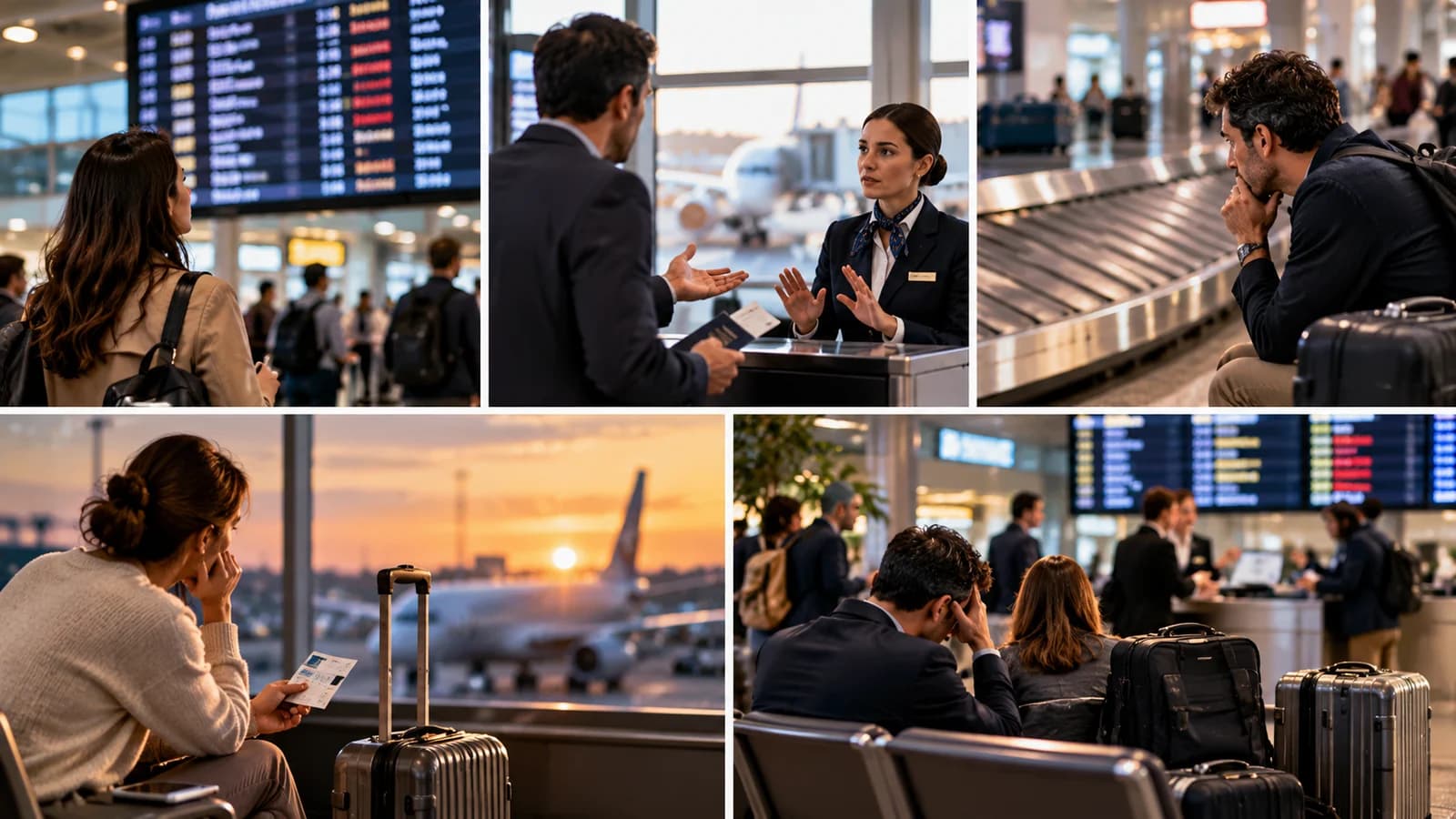
BEFORE YOU BEGIN
Go straight to the section you need.
Delays, cancellations, overbooking, baggage and routes of recourse are organized in separate sections. You can open the headings to read them and move between topics from the section menu. The numbers in square brackets link to the sources at the end of the page.
Summary
A flight delay, a cancellation, denied boarding due to overbooking and lost baggage are not the same legal event; each has different conditions, means of proof, routes of recourse and methods of calculating compensation. In Türkiye, the SHY-YOLCU Regulation sets minimum safeguards, particularly for denied boarding, cancellations, certain delays and changes of class of service. For baggage in international carriage, actual damage caused by delay and bodily injury to passengers, the Montreal Convention is also important. On flights connected with EU countries, EU passenger rights may come into play depending on the operating carrier and the points of departure and arrival. To avoid losing rights, a written record should be kept at the time of the incident, and the time limits and claims belonging to different legal regimes should not be confused with one another.
Which legislation are passenger rights based on?
An air passenger is not merely a customer subject to the carrier’s ticket conditions. The applicable national legislation and international conventions provide minimum protections that are independent of the standard terms and conditions of the ticket. Nevertheless, it is not correct to apply the same regulation to every dispute. First, the departure and arrival points of the flight, the company that will actually operate the flight, the date of the incident, the nature of the booking and the subject of the claim should be determined.
Türkiye: SHY-YOLCU and Turkish Civil Aviation Law No. 2920
The SHY-YOLCU Regulation of December 3, 2011 governs denied boarding (Art. 5), cancellation (Art. 6), delay (Art. 7), fixed compensation (Art. 8), ticket refund or re-routing (Art. 9), care and assistance (Art. 10), change of class of service (Art. 11) and the protection of persons with special needs (Art. 12). The amendment of December 10, 2024 specifically regulated, for the purposes of Art. 8–9, cases in which a flight delayed for technical and operational reasons brings the passenger to the final destination three hours or more late. The personal and flight scope of the Regulation is determined under Art. 2; as a rule, the relevant scheduled and non-scheduled flights operated by Turkish carriers to/from airports in Türkiye and by foreign carriers from airports in Türkiye are examined. [1] [2]
Turkish Civil Aviation Law No. 2920 contains general and specific provisions on the air carriage relationship. When baggage and carriage liability on domestic flights is assessed, the relevant provisions of the Law and its references to international rules should also be examined. Whether the company is Turkish or foreign, and whether a flight merely arrives in Türkiye, do not produce the same legal outcome for the application of SHY-YOLCU. [15]
Montreal Convention: baggage and proven damage
The 1999 Montreal Convention, to which Türkiye is a party, governs, in international carriage by air where its conditions are met, the loss of, damage to and delay of checked baggage; damage caused by delay in the carriage of passengers and baggage; and certain incidents of passenger injury/death. Articles 17, 19, 22, 31 and 35 of the Convention are particularly important in this guide. The SDR (Special Drawing Right) amount under Montreal is in most cases an upper limit of liability for actual damage; unlike the fixed compensation of 100/250/400/600 euros under the Turkish passenger rights rules, it is not paid automatically. [4] [5] [14]
European Union: entry into force and application are distinct in the 2026 amendment
EU Regulation 261/2004 may generally apply to flights departing from airports within the EU/EEA and to flights operated by an EU carrier from a third country to an airport within the EU/EEA. The undertaking that actually operates the flight, the integrity of the booking and any corresponding protection obtained in the third country are also assessed. For Switzerland and the United Kingdom, the relevant local/special regimes should be checked. A Turkish carrier flying from Türkiye to the EU does not in every case give rise to EU 261 compensation merely because the destination is in the EU; by contrast, on a flight from the EU to Türkiye with a Turkish carrier, EU rules may come into play. [6] [7]
The European Union’s amending Regulation No. 2026/2202 was published on October 2, 2026. Although the Regulation will enter into force on October 22, 2026, it will apply from October 23, 2027. The new text includes a prohibition on denying a passenger boarding on the return flight solely because they did not take the outbound flight, additional protections for passengers with disabilities, and clarifications on baggage and re-routing. As of October 18, 2026, these should not be asserted as if they were rights that had replaced the current 2004/261 practice. [8]
Which rights may arise in which situation?
| Situation | Main source of minimum protection | Key distinction |
|---|---|---|
| Arrival at least 3 hours late for technical/operational reasons | SHY-YOLCU Art. 7/3 and Art. 8–9 | Compensation depends on the cause of the incident and the applicable exceptions. |
| Expected departure delay | SHY-YOLCU Art. 7 and Art. 10 | The threshold for the right to care while waiting varies with flight distance. |
| Flight cancellation | SHY-YOLCU Art. 6, 8–10 | The time of notice, the alternative flight and the extraordinary circumstances defense are examined. |
| Involuntary denied boarding due to overbooking | SHY-YOLCU Art. 5, 8–10 | First a call for volunteers, then fixed compensation and the rights of choice. |
| Loss of, damage to or delay of baggage | Montreal Art. 17, 19, 22, 31, 35; TSHK | Proven actual damage, the time limit for written notice and the SDR limit. |
| Return leg cancelled because the outbound leg was not used | Ticket contract; TKHK Art. 5; TMK Art. 2 | No automatic and unconditional compensation outcome under Turkish law; a review for unfair terms is required. |
| Being left without assistance because of disability | SHT-ENGELSİZ, SHY-YOLCU and the applicable foreign regime | Accessibility, prevention of discrimination and the duty of special assistance. |
Passenger rights when buying a ticket and before the flight
Ticket price, ancillary services and contract terms
Before a ticket is purchased, the total price, taxes, mandatory charges, cabin and checked baggage allowance, seat selection, and change and cancellation conditions should be shown in an understandable way. It cannot be assumed that a cheap ticket automatically grants free baggage, free changes or a right of withdrawal at any time. Nevertheless, standard terms that are not clearly disclosed, or that create an imbalance to the consumer’s detriment contrary to the principle of good faith, may be subject to review for unfair terms under Article 5 of Law No. 6502. The fare conditions presented in advance, the purchase screens and the payment statement are evidence. [16]
A passenger’s own decision to cancel is different from the company cancelling the flight. In the former case, the ticket’s contractual refund/change conditions apply; in the latter, the rights of choice under the specific passenger rights rules may apply. It cannot be said that every online ticket carries an unconditional 14-day right of withdrawal; the specific exceptions for distance contracts are checked separately. Where the flight schedule is later changed significantly, whether the passenger consented to the change and the alternative offered are assessed separately.
Check-in, gate closure and travel documents
Holding a confirmed booking does not on its own constitute an assurance of boarding in every circumstance. Passengers are expected to complete check-in and boarding formalities at the time notified to them and to meet the requirements of a valid passport, identity document, visa/residence permit and the destination country. SHY-YOLCU Art. 2 takes as its basis, under certain conditions, presenting oneself at the notified check-in time or, if no time has been notified, no later than 45 minutes before the published departure. The time of arrival at the gate and the time the gate actually closed should also be documented. Denied boarding on valid safety/security grounds or because of inadequate travel documents is not treated in the same way as overbooking. [1]
Incorrect or incomplete communication of entry requirements by the airline or travel agency may give rise to separate contractual liability; however, the airline’s statement does not by itself create a right of admission to the country concerned. Passengers with health conditions, pregnancy, medical devices or a need for an escort should check the carrier’s published safety conditions in advance and submit any necessary request for assistance in a documented way.
Does not taking the outbound flight cancel the return ticket? (No-show)
Some air carriers require outbound and return coupons to be used in sequence and may remove the return ticket from the system for a passenger who did not use the outbound flight. For Türkiye, it cannot be concluded that this practice is automatically unlawful in every case or that it entitles every passenger to fixed SHY-YOLCU compensation. Whether clear information was given at the time of ticketing, whether the term was negotiated, whether the trip was arranged under a single contract and whether a disproportionate imbalance arose to the consumer’s detriment are examined under TKHK Art. 5 and TMK Art. 2. [16]
A passenger who wishes to use the return journey should notify the airline in writing as soon as they learn that they missed the outbound flight, ask for the return coupon to be kept open and keep the reply received. Where a new flight is purchased without permission, it cannot be assumed that its cost will be reimbursed automatically; breach of contract, damage, an appropriate causal link and reasonable steps to mitigate the damage are assessed. The EU’s new Regulation No. 2026/2202, which includes the no-show prohibition, will begin to apply on October 23, 2027. [8]
Is there a right to switch to an earlier flight free of charge?
A passenger who arrives at the airport early and sees an empty seat on an earlier flight the same day does not, on that basis alone, acquire a right to an earlier flight free of charge. This may be possible with a flexible ticket, under the airline’s current fare conditions, through a loyalty program or with its express approval. Re-routing that the company is required to provide because of a cancellation or delay is different from this voluntary change to an earlier flight.
Flight delay: departure and final arrival are assessed separately
At what delay does free assistance while waiting begin?
Under SHY-YOLCU Art. 7/1, the expected departure delay and the flight distance are taken into account for the duty of assistance to arise. The thresholds are 2 hours for domestic flights and flights of up to 1,500 km, 3 hours for flights in the 1,500–3,500 km range and 4 hours for flights over 3,500 km. Once a threshold is reached, the carrier should offer the care and information services under Art. 10. These thresholds should not be confused with the thresholds for automatic fixed compensation. [1]
| Expected departure delay | Flight scope | Minimum assistance the passenger may request |
|---|---|---|
| 2 hours or more | Domestic flights and flights of up to 1,500 km | Drinks/appropriate refreshments and communication under Art. 10 |
| 3 hours or more | 1,500–3,500 km | Refreshments in proportion to the wait and communication under Art. 10 |
| 4 hours or more | Over 3,500 km | Refreshments in proportion to the wait and communication under Art. 10 |
| Departure on the following day or a later day | All flights within scope where the conditions are met | Necessary accommodation and airport–hotel transfer |
| Delay of at least 5 hours | Under the conditions of Art. 7/1 | Refund under Art. 9/1-a and the related return option if the passenger abandons the journey |
Under SHY-YOLCU Art. 10, a wait of two to three hours entails reasonable hot and cold drinks; three to five hours, drinks plus breakfast or a meal depending on the time of day; and five hours or more, additional drinks and a light snack on top of these. Where necessary, a hotel and airport–hotel transfer and two free telephone calls, faxes or emails should be offered. A passenger’s reasonable and documented expenses cannot be rejected out of hand on the ground that food at the airport is expensive; on the other hand, reimbursement of disproportionate spending in full is not guaranteed. [1]
Reaching the final destination at least three hours late and fixed compensation
With the amendment of December 10, 2024, where a delay occurring for technical and operational reasons causes the passenger to reach the planned final destination three hours or more late, the obligations under Art. 8 and Art. 9 come into play pursuant to SHY-YOLCU Art. 7/3. Even if the departure delay reaches three hours, where the final destination is reached two hours late, automatic fixed compensation does not follow merely from the departure time; the right to services under Art. 10 is assessed separately. [2]
This amendment is distinct from the case law on past disputes. For example, in the decision of the Court of Cassation (Yargıtay), 11th Civil Chamber, January 27, 2022, E. 2021/3736, K. 2022/704, it was held that, under the rules in force at the time, a five-hour delay alone was not treated as a cancellation and did not give rise to compensation under Art. 8. This decision cannot render ineffective Art. 7/3, which was expressly added in 2024; the dates of the incidents must be kept apart. [12]
Delay of five hours or more: ticket refund and return
Where the delay reaches at least five hours, SHY-YOLCU Art. 7/1 brings into play the reimbursement option under Art. 9/1-a. The passenger may state that the journey no longer serves its purpose and, depending on the scope, request a refund of the unused part, a refund of the used part where the purpose of the connected journey has been lost and, where necessary, a free return to the first point of departure. A passenger choosing to continue the journey and a passenger abandoning the ticket and requesting a refund are not making the same claim; the choice made should be recorded in writing. For refunds, Art. 9 provides for a period of no more than seven days. [1]
Do extraordinary circumstances remove all rights?
No. Weather unsuitable for flight, airspace closure, a safety threat and other extraordinary events affecting the flight may, under certain conditions, remove the carrier’s liability for fixed compensation; however, providing information to the passenger, the necessary care and appropriate refund/re-routing options do not disappear automatically. The carrier should substantiate the cause, how the event affected the flight in question and the reasonable measures that could be taken. A one-word “technical” explanation for an aircraft fault, or declaring every strike “force majeure” under the same conditions, is not an adequate legal assessment. [1] [9]
Incident records, METAR/TAF meteorological documents, NOTAMs, slot/ATC records, the planned and actual flight log, the airline’s announcements and the notifications sent to the passenger may be at issue. The passenger may not be able to obtain all of these technical records themselves; in a specific dispute, it may be requested that they be produced by the carrier or obtained from the relevant authorities.
Waiting on board or on the apron
After boarding has been completed, the aircraft waiting on the apron may also affect the final arrival time. For Türkiye, no general and unconditional rule should be asserted to the effect that anyone waiting on board for hours may leave the aircraft after a certain number of minutes; aviation safety and operational requirements are also important. The passenger’s health needs, water/basic needs, information and the duty to take reasonable measures are assessed in the specific case. The EU’s new rules, which will apply in 2027, regulate rights concerning waiting on board and disembarkation in more detail; they should not yet be presented as applicable provisions. [8]
Flight cancellation: advance notice does not remove every consequence
Three separate groups of rights that must be offered to the passenger
When a flight is cancelled, there are rights that the airline must assess separately: (i) refund of the ticket price or carriage by an alternative route, (ii) care and assistance during the waiting time, (iii) fixed compensation where the conditions are met. None of these automatically replaces another. Instead of a ticket refund, the passenger may choose to travel on the earliest suitable flight under comparable conditions or, subject to seat availability, to fly at a later date of their choosing. Where the alternative is to another airport, the cost of a suitable transfer may be the carrier’s responsibility. [1]
The airline should inform the passenger of the cancellation and provide information about alternative transport. The date on which the passenger received notice directly affects the statutory compensation exception. In response to the defense “we sent an email a week ago,” the existence of the email, the contact details the passenger provided in advance and the transmission records are examined. Art. 6 expressly provides that the burden of proving that notice of cancellation was given, and when, lies with the carrier. [1] [3]
How are the 14-day and 7-day thresholds applied?
Notice periods and compensation exceptions
Under SHY-YOLCU Art. 6/2, a passenger informed at least 14 days in advance may not acquire the right to fixed compensation because of the exception relating to the time of notice; however, the rights to a ticket refund or re-routing are assessed separately. For notice given 7–14 days before, offering a suitable alternative that departs no more than two hours earlier and arrives no more than four hours later, and for notice given less than 7 days before, offering an alternative that departs no more than one hour earlier and arrives no more than two hours later, is important for the compensation exception. Independently of these exceptions, extraordinary circumstances and their proof are examined separately. [1]
| Notice of cancellation to the passenger | Key threshold for fixed compensation | Right to be examined separately in every case |
|---|---|---|
| 14 days or more before the scheduled departure | The compensation exception tied to the time of notice may come into play | Refund or suitable re-routing |
| 7–14 days before departure | An alternative departing no more than 2 hours earlier / arriving no more than 4 hours later | Refund, re-routing and, depending on the situation, services |
| Less than 7 days before departure | An alternative departing no more than 1 hour earlier / arriving no more than 2 hours later | Refund, re-routing, services; compensation separately |
| At the airport or very close to departure | If options have not been offered, the conditions for compensation may be strengthened | Written record, refreshments, accommodation, transfer |
Effect of the alternative flight on other passenger rights
Offering the passenger a later flight after a cancellation does not mean that the right to compensation lapses automatically. It may also be important whether the flight claimed to have been cancelled was in fact operated under a changed flight number: a genuine cancellation, a schedule change and a delay are assessed under different conditions.
Overbooking and denied boarding
Not every instance of denied boarding is overbooking
Selling tickets in excess of capacity, that is, accepting more bookings than the aircraft’s actual capacity, may result in a shortage of seats when all passengers show up. SHY-YOLCU Art. 5 requires the carrier first to call for passengers willing to voluntarily surrender their reservations in exchange for certain benefits. Where there are not enough volunteers, the obligations under Art. 8, 9 and 10 may arise when a passenger holding a valid ticket and meeting the necessary entry requirements is denied boarding against their will. [1]
A valid health/safety/security impediment, a missing passport/visa, late check-in, behavior by the person that endangers safety, or failure to go to the boarding gate on time do not fall into the same category. The passenger should ask for the reason why they were denied boarding to be entered in a written record. The response “the aircraft is full” and the explanation “the passport is not valid” have entirely different consequences. [1]
Voluntary surrender must be distinguished from being involuntarily left behind
If the passenger voluntarily agrees to transfer to a later flight, the benefit offered (voucher, cash, seat, hotel) and its relationship with the rights under Art. 9 should be clearly set out in writing. The fact that the carrier has the passenger sign a standard claim form does not mean that it has obtained an automatic and valid waiver of all relevant statutory rights. A passenger involuntarily denied boarding does not have to prove specific economic damage in the same way for a standard compensation claim; the right arises under the conditions of SHY-YOLCU. [1]
At the time of the incident, the booking code, e-ticket, boarding pass, check-in time record, the gate agent’s explanation, any “involuntary denied boarding” note, the alternative ticket and expenses should be kept. If the airline offers a free voucher, this should not prevent statutory cash compensation and travel options from being assessed separately.
Why are fixed compensation, care and ticket refunds different amounts?
SHY-YOLCU amounts as of 2026
Fixed compensation amounts on domestic and international flights
Where the conditions referred to in Art. 8 of the Regulation are met, the standard compensation amounts provided for are as follows:
| Flight type / distance | Standard compensation |
|---|---|
| Domestic flights within Türkiye | Turkish lira equivalent of 100 euros |
| International — 1,500 km or less | Turkish lira equivalent of 250 euros |
| International — between 1,500 and 3,500 km | Turkish lira equivalent of 400 euros |
| International — over 3,500 km | Turkish lira equivalent of 600 euros |
Payment exchange rate and reduction of compensation
When the Turkish lira equivalent is calculated, the foreign exchange selling rate of the Central Bank of the Republic of Türkiye (TCMB) on the date of payment is used. The great circle method is used to calculate distance. If the passenger is brought by a suitable alternative flight no more than 2/3/4 hours, depending on distance, after the planned arrival, a 50% reduction in compensation may come into play under the conditions of Art. 8/3. This is not an automatic reduction for every delay, nor a discount on the ticket price; the conditions for its application are examined in the specific case. [2]
Are compensation, refund and care offset (mahsup) against each other?
Fixed compensation is the standard payment linked to a delay/cancellation/denied boarding event when the legal conditions are met. A ticket refund is the return, in accordance with the contract, of the price of an unused carriage service or of a part of the journey that no longer serves the purpose of travel. Care services, on the other hand, consist of providing food and drink while waiting, necessary accommodation, transfer and communication. Meeting one does not in every case extinguish the existence of another. By contrast, double recovery from two separate compensation mechanisms for the same damage is not acceptable either; the extent to which the same interest has been compensated is examined. [1] [6]
Cash or voucher? Why does the passenger’s acceptance matter?
The payment methods provided for in SHY-YOLCU Art. 8/4 and Art. 9/1-a include cash, bank transfer and similar methods; the passenger’s signed agreement is required for payment by travel voucher or in the form of other services. Presenting a travel credit pre-selected by default on a screen, or an unsolicited voucher, cannot be regarded as performance of the statutory obligation without examining the consent of the parties and the specific arrangement. The relationship between the ticket refund and the price actually paid by the purchaser and the payment method is reviewed separately. [1]
Missed connections on connecting flights, new tickets and alternative airports
On a journey with connections, the key question is whether the trip is made under a single booking/single contract of carriage or with tickets independent of each other. A delay on the first leg of a connecting flight under a single contract may change the time of reaching the final destination; the concept of final destination is important in the three-hour assessment under Art. 7/3. Where a separately purchased second ticket is missed, however, it cannot be argued that the first carrier is automatically liable for all costs along the chain; foreseeable damage and causation are examined separately. [1] [6]
In the event of a cancellation, or where a statutory right to re-routing arises, the passenger may request that the earliest suitable alternative under comparable transport conditions be offered. Offering only the company’s own flight may be assessed in terms of whether earlier reasonable options were disregarded. Full reimbursement of an excessively expensive alternative ticket purchased by the passenger on their own is not guaranteed: the company’s earlier offers, the urgency of the request, reasonable expenses and evidence are important.
If a landing at another airport serving the same city is offered, the carrier must bear the cost of transfer to the airport for which the booking was made or to another nearby destination agreed to by the passenger, pursuant to SHY-YOLCU Art. 9/3. The distance between the airports and a transfer taking place at night may be important in terms of actual expenses. [1]
Passenger rights on upgrading and downgrading
For moving a passenger to a higher class than the one purchased, it is not possible for the airline to charge an additional fee. If the passenger is placed in a lower class of service, under SHY-YOLCU Art. 11, in addition to a refund of the difference between the ticket prices, payment within seven days of 30%, 50% or 75% of the ticket price, depending on distance, comes into play. These rates are set respectively for flights of up to 1,500 km; between 1,500 and 3,500 km; and over 3,500 km. The carrier cannot close the file simply by stating “we paid the difference between economy and business” without addressing the other obligation under Art. 11. [1]
The passenger should document the ticket/invoice showing the class of service purchased, a check-in screenshot, the new boarding pass issued and the cabin class actually provided. The airline must use the prices as of the ticket purchase date and apply the reduction rate to the correct base. The calculation for downgrading is different from the fixed euro compensation for a flight cancellation.
Lost, damaged and delayed baggage and cabin baggage
First step when baggage does not arrive: filing a PIR
When a checked suitcase is not on the baggage belt, having a Property Irregularity Report (PIR) or an equivalent irregularity report drawn up at the relevant lost property/carrier desk before leaving the airport is very important for proof. The baggage tag, boarding pass, ticket, a photo of the suitcase, any list of contents, the tracking number and the flight code should be kept. One should not proceed on the assumption that a PIR will in every case replace the time limit for written complaints under Montreal Convention Art. 31; separately sending written notice to the carrier in time is the safe approach. [5]
After how many days is baggage considered lost?
Under Montreal Convention Art. 17/3, if the carrier admits the loss of the baggage or if checked baggage has not arrived by the end of 21 days from the date on which it ought to have arrived, the passenger may assert the relevant rights arising from the contract of carriage. This does not mean that no action should be taken during the 21 days. Necessary clothing/hygiene expenses incurred earlier may be documented separately in respect of the baggage delay. [5]
Time limits for written notice in case of damage and delay
Under Montreal Convention Art. 31, it is important to make a written complaint to the carrier, in the case of damage to checked baggage, no later than seven days from receipt and, in the case of delay, no later than 21 days from the date on which the baggage was placed at the passenger’s disposal. Art. 17/3, under which baggage is deemed lost after 21 days, and the 21-day time limit for written notice concerning delayed baggage are separate rules. Where possible, the airline’s registration system, email and proof of receipt should be used together for the notice. [5]
| Baggage event | Time limit / action | Evidence |
|---|---|---|
| No baggage on the belt | Immediate PIR or an equivalent lost baggage report | Baggage tag, flight document, tracking number |
| Damaged checked baggage | Written complaint no later than 7 days from receipt | Photos of the damage, date of receipt, repair invoice |
| Delayed checked baggage | Written complaint no later than 21 days after the baggage is placed at the passenger’s disposal | Expense receipts, time of delivery, communications |
| Checked baggage never arriving | 21 days passing from the date on which it ought to have arrived, or admission of the loss | Evidence of contents and value, PIR, tracking record |
| Action for damages under Montreal | 2 years under Art. 35 of the Convention | Date of arrival/date on which it ought to have arrived, litigation and service documents |
What is 1,519 SDR? It is not fixed compensation
In international carriage, under Montreal Convention Art. 22/2, from December 28, 2024, the upper limit of liability for the loss of, damage to or delay of baggage is, as a rule, 1,519 SDR per passenger. This amount applies per passenger, not per suitcase, and is not automatic compensation. Actual damage, the value of the item, reasonableness, proof, a special declaration of value and other exceptions are examined separately. The SDR is the IMF’s Special Drawing Right unit of account; for conversion relating to payment, the applicable date and the official exchange rate method must be determined according to the specific legislation. [4]
In the decision of the Court of Cassation, 11th Civil Chamber, June 27, 2018, E. 2016/12411, K. 2018/4854, it was explained that clothes bought for daily needs by a passenger whose baggage was delayed for days may constitute pecuniary damage, but that, since the items remained in the passenger’s assets, the actual damage should be calculated in the specific case by also applying an equitable reduction. This decision shows that claiming these rights requires a more detailed review of the calculation than merely attaching a receipt. The SDR limit applicable on the date of the incident in the decision cannot be used in place of the current 1,519 SDR. [11]
Valuables, baggage contents and special declaration
Packing valuable jewelry, important work documents, expensive electronic devices or vital medication in baggage can be risky. Carriers’ rules on special carriage and prohibited items should also be considered. Under Montreal Art. 22/2, the limit of liability may differ where a special declaration of value is made when the baggage is handed over to the carrier and any required additional payment is made. A passenger later preparing a unilateral list of high values does not mean that the contents and their value have been proven.
In the case of damage, the repair invoice, the price and the age of the item; in the case of loss, proof of purchase, images, bank transactions and baggage weighing records; and in the case of delay, reasonable emergency expenses appropriate to the destination and the purpose of travel are important. It cannot be assumed that the price of a brand-new product will be paid in every case for used items. The absence of photos or invoices for the items does not make the claim impossible; however, it makes proof more difficult. [5] [11]
Cabin baggage, hand baggage and personal items
Fee and size conditions for cabin baggage are assessed within the framework of the fare, security rules and the applicable law. The liability regime for damage to checked baggage is not the same as that for damage to items in the cabin; under Montreal Art. 17/2, for unchecked baggage, the existence of fault on the part of the carrier or its servants may become significant. The provisions on personal items and cabin baggage in the EU’s Regulation 2026/2202, which will apply in 2027, should not be presented as if there were already a right to a free cabin suitcase on all Türkiye flights today. [5] [8]
Children, pregnant passengers and passengers with disabilities or reduced mobility
Accessibility and assistance
In Türkiye, the SHT-ENGELSİZ Instruction sets out the principles on protecting passengers with disabilities or reduced mobility against discrimination and on assistance services. As a rule, denying boarding to a person holding a valid ticket solely because of their disability is not acceptable; there may be genuine and reasoned exceptions relating to aviation safety. Advance notification of the request for assistance, information on the wheelchair/mobility device and whether access to the aircraft is possible are important. [10]
Access to the airport, boarding/disembarkation assistance, the need for an escort, the conditions for carrying mobility equipment and the continuation of assistance in the event of a delay should be assessed separately. Persons with reduced mobility, their companions and children traveling alone should receive special attention in care and assistance (SHY-YOLCU Art. 10/3). Since damage to a wheelchair or medical device may give rise to specific losses different from those for an ordinary suitcase, the contract, the insurance policy and the legal regime should be examined together. [1] [10]
Infants, children and traveling alone
Ticketing fares for infants and children, seat allocation, escort, identity and age conditions are determined by the air carrier’s announcements and the applicable law. Keeping parents and children together, supervision, special meals and necessary care should be assessed particularly in the event of a flight cancellation or delay. Parents should check whether a separate ticket/seat was purchased for the child and the scope of the minimum rights. It is not correct to assert the new provisions on seating families together that will apply in the EU from 2027 in Türkiye today as an absolute right to free seat selection. [8]
Pregnancy, health problems and medical travel
The acceptance of pregnant passengers for a flight may involve medical report requirements linked to the week of pregnancy and the airline’s safety rules. A passenger with a chronic illness or a need for oxygen, medication or other medical assistance should notify this in advance through the required channel and provide the report with due regard for personal data security. A legal distinction should be made between a carrier’s lawful condition imposed for safety purposes and arbitrary obstruction. For pecuniary and non-pecuniary damage claimed because of a missed medical appointment, specific documents and the causal link must be assessed. [10] [13]
Aircraft accidents, bodily injury and passenger health
Montreal Convention Art. 17 sets out special rules on the carrier’s liability in the event of the death or bodily injury of a passenger resulting from an accident on board the aircraft or in the course of the operations of embarking or disembarking in international carriage. This area is legally separate from ordinary delay compensation; whether the event is genuinely an aviation accident, the place of the accident, the cause of the injury, medical records, other liable parties and causation are assessed separately. Updated on December 28, 2024, the amount of 151,880 SDR relates to the first tier of liability under Montreal Art. 21; it cannot be used as an absolute overall payment cap in all death or injury cases. [4] [5]
An accident at an airport facility, an assault by another passenger, a slippery floor or the fault of an independent ground handling service is not always subject to the same legal regime as the contractual carriage liability under Montreal between the passenger and the air carrier. Footage of the scene, witness details, records of medical intervention, written records, insurance policies and any findings by law enforcement should be preserved without delay. It is not correct to treat an illness or stress on its own as an “aircraft accident”; separate grounds for claims are examined.
Additional pecuniary damage, non-pecuniary damage and insurance
What must be proven for damage exceeding standard compensation?
Apart from fixed SHY-YOLCU compensation, a missed international connection, a re-purchased ticket, an unused hotel, a prepaid tour price, and necessary taxi and accommodation costs may, under certain conditions, become the subject of a dispute over actual damage. Each expense must have arisen as a result of the incident, be documented and be reasonable, and the same expense must not already have been covered through another mechanism. The mere fact that the flight was delayed does not automatically place the entire claimed loss of commercial profit on the company. [5] [11]
For passenger delay damage covered by the Montreal Convention, the liability conditions under Art. 19 and the upper limit of 6,303 SDR per passenger applicable under Art. 22/1 from December 28, 2024 should be taken into account. This amount is not the SHY-YOLCU fixed compensation amount; proof of actual damage and the other relevant contractual rules are also required. When several legal grounds are invoked, the scope of application of the Convention, the limitation of liability and the prohibition of double recovery should be assessed separately. [4] [5]
Does every delay give rise to non-pecuniary damages?
No. The discomfort caused by an ordinary delay should be distinguished from a violation of personality rights, serious hardship or other special conditions that legally require compensation. The applicable law and the nature of claims within the scope of Montreal are important. In the decision of the Court of Cassation, 11th Civil Chamber, March 5, 2015, E. 2014/18302, K. 2015/2987, in a case where ticket and taxi costs after a cancellation were awarded, it was concluded that the additional conditions put forward for non-pecuniary damage had not been sufficiently proven; a dissenting opinion was also written against the decision. Since the incident date of this decision is old, it should not be presented as a compensation decision concerning the 2024 amendment to SHY-YOLCU. [13]
Travel insurance, card coverage and package tours
Flight disruption insurance, credit card travel protection, the package tour organizer’s liability or an employer’s policy are coverage distinct from the airline’s statutory obligation. The delay period, event exclusions, the fate of the baggage, the time limit for claim notification and document requirements may vary in the policy. Double recovery of the same damage from more than one source should also be prevented. How a flight cancellation within a package tour affects the performance of the entire tour is assessed together with Law No. 6502 and the package tour regulations. A general approach of “the airline gave a voucher; there is no longer any package tour right” is not legally sound.
How do rights overlap in Türkiye, the European Union and other countries?
Example application map for Türkiye–EU flights
In applying EU 261/2004, what matters is not nationality but where the flight departs from, where it arrives and whether the operating carrier is an EU carrier. For example, a flight from the EU to Türkiye actually operated by a Turkish airline may fall within the scope of the EU rule. On a Turkish-carrier flight from Türkiye to the EU, the same outcome is not automatic; for Türkiye, the application of SHY-YOLCU is examined separately. In journeys departing from the EU and connected with an EU carrier, establishing the integrity of the connection is important. [6] [7]
| Flight pattern | Primary review | Warning |
|---|---|---|
| İstanbul–Antalya, Turkish carrier | SHY-YOLCU and Turkish law | 100 euros if the conditions for domestic fixed compensation are met |
| İstanbul–Berlin, Turkish carrier | SHY-YOLCU; where necessary, the international contract of carriage | EU 261 does not apply in every case merely because the destination is in the EU |
| Berlin–İstanbul, Turkish carrier | EU 261; the Türkiye connection and overlap | Departure from the EU usually falls within the scope of EU 261 |
| İstanbul–Paris, EU carrier | Scope of application of EU 261 and SHY-YOLCU | Payment twice for the same damage under the two sets of rules is not to be expected |
| Antalya–London, different flight operators | Local rules of Türkiye and the United Kingdom | A separate regime, as the United Kingdom is not an EU member |
| Two independent connecting tickets | Separate analysis for each contract and flight | The first carrier does not automatically guarantee the subsequent ticket |
The application date of October 23, 2027 of the new EU 2026/2202 rules is important particularly with regard to no-show, seating together, new connection and baggage rules. It should not be asserted that today’s passengers can have automatic action taken on the basis of a 2027 right. The local law of another country applicable to the flight, the Montreal Convention and the contract of carriage may also be researched. [8]
Routes of recourse: the airline, the Directorate General of Civil Aviation (SHGM), the arbitration committee and the courts
The first application should be made to the airline in writing
In a dispute over a delay, cancellation, overbooking or downgrading, the application is first made to the air carrier operating the flight. The application sets out separately the booking/PNR, the flight number and date, the actual delay or cancellation information, the items of rights claimed and the evidence. The company’s reply number or file/claim reference is obtained. Purchasing the ticket from a travel agency does not by itself remove the operating carrier’s liability under the specific passenger rights rules. Nevertheless, ticketing operations arising from the agency’s own error are assessed separately from a contractual perspective. [3]
Circular No. HUD-2023/1 of SHGM provides that an application may be made to SHGM if the airline does not respond to the application within 10 days or if its response is inadequate. The difference between the 6-week wording found on one of SHGM’s old complaint pages and the 2023 Circular should be assessed in light of the current official screen for the application route and the type of norm. Taking action earlier is beneficial for the applicant in terms of proof and certainty as to time limits. [3] [9]
Which complaints does SHGM handle, and which does it not?
According to SHGM’s official statement, SHY-YOLCU applications concerning denied boarding, cancellation, delay and placement in a lower/higher class are examined in the relevant system. Lost baggage, ticket cancellation at the passenger’s own request without any flight disruption, tax refunds or ticketing errors are not assessed in the same administrative passenger rights procedure. For such claims, a written dispute with the carrier, consumer law or a judicial application within the scope of Montreal is pursued separately. [3] [9]
For current SHGM passenger rights guidance, the official page can be used via kdmerp.shgm.gov.tr. Identity details, contact details, flight documents, and the complaint made to the airline and its reply should be prepared for the application. Applying through an attorney-in-fact may require special procedures and documents of authority. SHGM’s administrative review does not in every dispute replace a private law judgment awarding the claim; filing a lawsuit and time-limit steps should be tracked separately. [3] [9]
Consumer arbitration committee and consumer court
Monetary threshold for arbitration committees in 2026
In an air carriage dispute that qualifies as a consumer transaction, the consumer arbitration committee (tüketici hakem heyeti) or the consumer court may come into play under the provisions of Law No. 6502 and depending on the value of the dispute. In 2026, consumer arbitration committees have jurisdiction over consumer disputes with a value below 186,000 Turkish lira (TL); for claims at or above the threshold, mediation as a condition precedent to litigation, where its conditions are met, and the consumer court route are considered. This monetary threshold may change every year and should not be carried over automatically to a 2027 claim. [16] [17]
Courts, mediation and subject-matter jurisdiction
Where the trip is made for commercial/professional purposes, the consumer status of the parties, the party to the contract and the court with subject-matter jurisdiction are examined separately. It cannot be said that applications to SHGM, arbitration committees, mediation and judicial routes are all substitutes for one another or mandatory stages to be followed in sequence in every case. The subject of the application, the suitability of parallel proceedings and the suspension of the administrative review because of court proceedings are assessed separately. [3]
The 2-year Montreal time limit for bringing an action for baggage, and other time limits
Under Montreal Convention Art. 35, the right to bring an action for damages may be extinguished if it is not exercised within two years reckoned from the date of arrival, the date on which the aircraft ought to have arrived or the date on which the carriage stopped. This special time limit cannot be generalized in the form “it is the single, universal two-year statute of limitations for all fixed compensation claims under SHY-YOLCU.” For these claims, the specific national time limit to be applied, the legal nature of the claim, the date of the event in dispute and conflict-of-laws rules should be researched separately. Nor can it be assumed that a complaint to the airline or an application to SHGM will in every case preserve the right of action and suspend all time limits. [5]
Matching action, right and document
| Dispute | Action to take first | Critical record | Recommended legal check |
|---|---|---|---|
| Delay | Ask the airline in writing for the reason and the actual arrival time | Ticket, notification, actual arrival | Art. 7/3 and the care/compensation distinction |
| Cancellation | Choose the refund or re-routing option in writing | Time of the cancellation SMS/email | 14/7-day exceptions |
| Denied boarding | Have the reason, and whether it was voluntary, entered in a written record | Boarding pass, gate record | Art. 5, 8, 9, 10 |
| Baggage not arriving | Open a PIR immediately, then make a written claim in time | Baggage claim tag, expenses | Montreal Art. 17, 31, 35 |
| Downgrading | Document the old/new cabin class | Ticket and new boarding pass | Art. 11 refund and rate calculation |
| No-show | Submit a written request to keep the return coupon open | Purchase condition and reply | Unfair terms, damage and causation |
The practical steps a passenger should follow when a flight is disrupted
During the incident, the first request should be for a written record and a clear presentation of the statutory options. An employee saying orally “no rights,” “force majeure” or “voucher only” does not eliminate a written and reasoned review. The following order of steps reduces the risk of losing rights:
- Keep the flight number, the PNR, the original booking and the boarding pass; also keep the new pass for the changed flight.
- Ask in writing for the reason for the cancellation, delay or denied boarding and for the actual departure/arrival time; save images of the departure board and your phone screen.
- State clearly whether you want a refund, the earliest suitable re-routing or a later date; note all of the company’s offers before choosing.
- Request refreshments, communication, accommodation and transfer assistance; if they are not provided, keep the invoices for reasonable expenses.
- In a baggage dispute, create a PIR record before leaving the airport and separately track the written notice time limits under Montreal Art. 31.
- Send a written claim with the company’s application number; separate which amount is fixed compensation, which is a refund and which is actual damage.
- Determine the SHGM or consumer court route suited to the specific legal regime; check mediation, threshold, time-limit and jurisdiction requirements separately.
- When a payment is made, check which claim it has been offset against and the scope of any release (ibraname) signed.
Common misjudgments in practice
“The plane was delayed three hours, so everyone gets 600 euros in every case.” Wrong. Domestic/international flight, distance, the actual delay at the final destination, the technical/operational cause, exceptions and the Art. 8/3 reduction are examined separately. On domestic flights, the amount under Art. 8 is 100 euros.
“In a cancellation due to weather, the carrier does not have to do anything.” Wrong. An exemption from fixed compensation does not in every case remove information, care and the rights of choice under Art. 9.
“Everyone automatically gets 1,519 SDR for baggage.” Wrong. In a specific international carriage, this amount is, as a rule, an upper limit per passenger; proof of actual damage is essential.
“I had a PIR filed; there is no other written notice or time limit for bringing an action.” Wrong. A PIR is a record of the incident; the written notice under Montreal Art. 31 and the time limits for bringing an action under Art. 35 are tracked separately.
“The new EU no-show prohibition applies to all flights in 2026.” Wrong. Amendment No. 2026/2202 applies from October 23, 2027; the contractual no-show debate in Türkiye, on the other hand, is examined under the existing consumer law rules.
“Writing only to SHGM is enough to obtain compensation.” Wrong. Administrative supervision, private law enforcement of the compensation claim and Montreal baggage actions may be subject to different procedures.
Conclusion
In air passenger rights, the outcome is not simply a calculation of a single “delay time” or “suitcase value.” The legal scope of the flight, the cause of the incident, the alternative chosen by the passenger, the actual time of final arrival, the items of damage and the application time limits should be assessed together. The right to a refund because of a cancellation, the right to services because of a delay and, under certain conditions, fixed compensation may each have separate legal bases in the same file; compensation for lost baggage, on the other hand, is often determined by proven actual damage and the limits of the Montreal regime. In particular, the time distinction between the 2024 amendment to the Turkish Regulation and the EU amendment that will begin to apply in 2027 must be drawn correctly. A passenger who preserves documents and time records at the first stage and applies to the authority appropriate to the nature of the claim provides a more solid basis for the legal review of their dispute.
Frequently Asked Questions
Does a departure three hours late automatically give rise to a right to compensation?
No. In Türkiye, SHY-YOLCU Art. 7/3 regulates a delay of three hours or more in final arrival for technical/operational reasons. The departure and final arrival times and the cause of the incident are examined separately. Even if the conditions for fixed compensation are not met, a right to care may arise.
When a flight is cancelled, can I ask for another flight instead of a ticket refund?
Yes. Under the conditions of SHY-YOLCU Art. 9, the options of a refund, re-routing under comparable conditions at the earliest opportunity, or a flight at a suitable later date subject to seat availability are considered. Where you are re-routed to another airport, the transfer is also important.
If I was denied boarding due to overbooking, what should I ask for?
If the conditions for involuntary denied boarding are met, you may request separately the fixed compensation under Art. 8, the refund/re-routing under Art. 9 and the rights to services under Art. 10. First have it put on record in writing whether volunteers were called for and what the real reason for the refusal was.
If they notify me of the flight cancellation 15 days in advance, do I have no rights left at all?
No. Appropriate advance notice may lead to the fixed compensation exception; it does not prevent the right to a ticket refund or re-routing from being assessed separately.
Can I get my ticket money back for a five-hour delay?
Under SHY-YOLCU Art. 7/1, a delay of at least five hours brings into play the reimbursement under Art. 9/1-a and, where its conditions are met, the provision on return to the first point of departure. The choice between abandoning and continuing the journey should be set out in writing.
If the airline does not provide a hotel, can I make a booking myself?
Where the right to necessary accommodation has arisen, the service should first be requested from the carrier; if it is not provided, reasonable and necessary expenses should be documented. Reimbursement of luxury or disproportionate spending in full is not guaranteed.
If my baggage does not arrive within 21 days, is 1,519 SDR paid automatically?
No. The 21-day period relates to the ability to assert rights concerning lost baggage under Montreal Art. 17/3. As a rule, 1,519 SDR is the maximum limit of liability per passenger; proof of actual damage is essential.
Within how many days should a complaint be made for damaged baggage?
Under Montreal Art. 31, in the case of damage to checked baggage, a written complaint no later than seven days from receipt is important. Creating a written record at the airport immediately is also recommended.
Can I claim the cost of the clothes I bought because my suitcase arrived late?
Depending on the circumstances of the incident, reasonable emergency expenses may be claimed as actual damage; invoices, the days on which the baggage was delayed and the purpose of travel are taken into account. The fact that the purchased items remain with the passenger may affect the equity calculation.
Is it lawful to cancel the return because I did not use the outbound flight?
Under Turkish law, a specific review is required within the framework of the contract and the information given to the consumer, unfair terms and the principle of good faith. Application of the specific prohibition in EU 2026/2202 will begin on October 23, 2027.
If the company cites weather conditions, is it released from providing refreshments and a hotel?
No. The extraordinary circumstances defense may affect fixed compensation in some cases; the rights to services, information, refund and re-routing are assessed separately.
Can I file a lost baggage complaint through SHGM?
SHGM’s SHY-YOLCU complaint system does not assess baggage disputes within this scope. For baggage, notice to the carrier and the applicable consumer/court route should be pursued separately.
What is the consumer arbitration committee threshold in 2026?
For 2026, consumer arbitration committees have jurisdiction over consumer disputes below 186,000 TL. Whether the dispute is a consumer transaction and the special international law rules should be assessed separately.
When flying from the EU to Türkiye with a Turkish airline, do I have EU passenger rights?
In general, on flights departing from the EU, the fact that the operating carrier is Turkish does not by itself exclude the scope of EU 261/2004. By contrast, the direct application of the EU Regulation on a Turkish-carrier flight from Türkiye to the EU is not the same.
I received fixed compensation; can I not sue for my other damage?
Other rights do not lapse categorically. However, additional damage is assessed subject to causation with the incident, genuine documents, the applicable Montreal/national limits and the prevention of double recovery.
Does my passenger rights application suspend the time limit for bringing an action?
A general assumption of suspension for all regimes is not correct. The special two-year time limit for bringing an action under Montreal Art. 35 should be examined separately from SHY-YOLCU fixed compensation and the time limits under consumer law.
BASIS AND CURRENCY
Sources and review information
- Directorate General of Civil Aviation (SHGM), Regulation on the Rights of Air Passengers (SHY-YOLCU), original text dated 03.12.2011 and current provisions. · Source check: October 18, 2026
- Official Gazette (Resmî Gazete), issue No. 32748 dated 10.12.2024, SHY-YOLCU Amending Regulation; amendments to Art. 7/3 and Art. 8. · Source check: October 18, 2026
- SHGM, HUD-2023/1, Circular on the Principles for the Assessment and Implementation of Passenger Rights, 26.01.2023. · Source check: October 18, 2026
- ICAO, 2024 Revised Limits of Liability Under the Montreal Convention 1999, SDR limits as of 28.12.2024. · Source check: October 18, 2026
- Montreal Convention 1999, Art. 17, 19, 22, 31, 35, official text of the Convention on EUR-Lex. · Source check: October 18, 2026
- European Commission — Your Europe, Air Passenger Rights: delay, cancellation and denied boarding. · Source check: October 18, 2026
- Regulation (EC) 261/2004, EUR-Lex, the applicable core EU regulation on air passenger rights. · Source check: October 18, 2026
- Regulation (EU) 2026/2202, Official Journal of the EU of 02.10.2026, date of application 23.10.2027, Art. 3. · Source check: October 18, 2026
- SHGM, For Passengers / Procedures and Principles for Passenger Rights Applications and the referral system. · Source check: October 18, 2026
- SHGM, Instruction on Air Passengers with Disabilities or Reduced Mobility (SHT-ENGELSİZ), 24.11.2015. · Source check: October 18, 2026
- Court of Cassation (Yargıtay), 11th Civil Chamber, 27.06.2018, E.2016/12411, K.2018/4854; actual damage and equitable reduction for delayed baggage. Full decision on De Jure (an access account may be required) · Source check: October 18, 2026
- Court of Cassation, 11th Civil Chamber, 27.01.2022, E.2021/3736, K.2022/704; the delay regime before the 2024 amendment to the Regulation. Decision on De Jure · Source check: October 18, 2026
- Court of Cassation, 11th Civil Chamber, 05.03.2015, E.2014/18302, K.2015/2987; proof of pecuniary/non-pecuniary damage in a cancellation, and the dissenting opinion. Decision on De Jure · Source check: October 18, 2026
- ICAO, Consumer Protection / overview of the Montreal Convention. · Source check: October 18, 2026
- SHGM, official statement on the Montreal Convention and carriage liability in Turkish civil aviation. · Source check: October 18, 2026
- Ministry of Trade of the Republic of Türkiye (T.C. Ticaret Bakanlığı), Law No. 6502 on Consumer Protection and consumer legislation. · Source check: October 18, 2026
- Ministry of Trade of the Republic of Türkiye, 2026 monetary thresholds for applications to consumer arbitration committees, 186,000 TL. · Source check: October 18, 2026
Each section’s source note is kept at the end of the relevant text.
The guide provides general information. The applicable law may vary depending on the specific flight and carrier, the dates, the booking structure, the evidence and the legislation in force.